 By Tanmay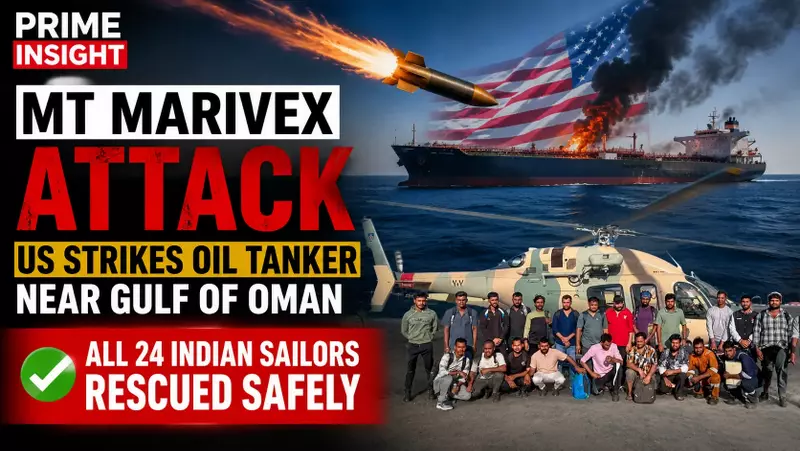
NEW DELHI — A high-stakes military operation has unfolded in the waters off Masirah Island after a US Navy fighter jet targeted and disabled an unladen oil tanker carrying 24 Indian crew members. The targeted vessel, identified as the MT Marivex, caught fire immediately after the strike. Fortunately, a swift international response ensured a successful Indian sailors rescue mission, with all crew members brought to safety without injuries.
This comprehensive report breaks down the strategic factors behind the MT Marivex attack, the execution of the strike, and India’s official diplomatic stance.
The Genesis of the MT Marivex Attack
The high-seas interception stems from escalating regional tensions. Following recent threats by Tehran to shut down the strategic Strait of Hormuz, the United States military implemented a strict, active US Iran blockade on all waterways leading to Iranian ports.
According to US Central Command (CENTCOM), the Palau-flagged MT Marivex—which was already blacklisted and sanctioned by the US Treasury’s Office of Foreign Assets Control (OFAC) for shipping Iranian petroleum—repeatedly attempted to bypass naval restrictions. Security sources revealed that the ship had turned back on three prior occasions after receiving warnings from American forces.
During its fourth attempt, the vessel entered Omani territorial waters and disabled its AIS transponder tracking signals to evade detection. This non-compliance directly triggered the subsequent military interception.
Precision Strike by the USS Abraham Lincoln
When the non-compliant vessel refused to alter its course, the US military launched a decisive enforcement action. The precision strike was executed by an F/A-18 Super Hornet fighter aircraft deployed from the aircraft carrier USS Abraham Lincoln.
CENTCOM confirmed that the fighter jet fired a precision munition directly into the tanker’s engineering and steering spaces. The impact disabled the vessel’s propulsion capabilities, effectively ensuring it was “no longer sailing to Iran,” but it also ignited a severe, fast-spreading Gulf of Oman ship fire.
High-Stakes Indian Sailors Rescue Operation
As the Strait of Hormuz ship fire spread and the disabled vessel began to sink off the coast of Oman, the crew transmitted an urgent SOS distress signal. What followed was a highly efficient, multi-agency rescue operation:
-
The Distress Signal: The Indian Coast Guard’s Maritime Rescue Coordination Centre (MRCC) in Mumbai intercepted the automated distress call and immediately mapped the vessel’s location near Masirah Island.
-
Tactical Coordination: The Indian Coast Guard rapidly shared critical telemetry and established a direct line of communication with Oman’s Maritime Search and Rescue Centre.
-
The Extraction: Moving swiftly, the Oman Navy deployed search-and-rescue helicopters directly to the burning tanker. Omani rescue teams successfully evacuated all 24 Indian seafarers from the vessel, safely transferring them to shore with zero casualties or injuries.
Lebanon Strikes Continue as Trump Netanyahu Call Heats Up Over Israel Lebanon Offensive
India’s Measured Position on the Interception
In the wake of the MT Marivex attack, New Delhi has maintained a carefully calibrated, pragmatic diplomatic posture.
Speaking at a media briefing, Ministry of External Affairs (MEA) spokesperson Randhir Jaiswal confirmed that the vessel was “disabled” off the coast of Oman and acknowledged that an exchange of communication had taken place between the ship’s crew and the US Navy right before the incident occurred.
While a parallel statement from India’s Ministry of Defence explicitly referred to the event as a “missile attack,” both ministries notably refrained from issuing a direct public condemnation of the United States. Instead, India’s diplomatic channels focused entirely on safety and welfare, publicly expressing profound gratitude to Omani authorities for their rapid, life-saving intervention.
The Broader Maritime Impact
US Central Command has reiterated that the ongoing naval blockade is strictly designed to isolate Iranian ports and does not target compliant commercial shipping navigating the region. Since early April, US naval assets have successfully diverted 134 ships away from restricted zones, while granting safe passage to 42 vessels carrying vital humanitarian relief supplies.
The structural damage suffered during the MT Marivex attack serves as a stark warning to non-compliant shipping networks operating within the volatile West Asian maritime corridors. The 24 rescued Indian nationals remain under the care of diplomatic officials in Muscat while repatriation procedures are finalized.

তন্ময় ‘প্রাইমইনসাইট’ (PrimeInsight)-এর প্রতিষ্ঠাতা ও প্রধান লেখক। কলকাতা-ভিত্তিক একজন উৎসাহী ব্লগার ও স্বতন্ত্র ভাষ্যকার হিসেবে তিনি গুরুত্বপূর্ণ বিষয়গুলোর ওপর তীক্ষ্ণ ও বাস্তবসম্মত দৃষ্টিভঙ্গি তুলে ধরেন।
সঙ্গীত, সমসাময়িক ঘটনাপ্রবাহ এবং রাজনীতি—এই ক্ষেত্রগুলোতে গভীর জ্ঞানের অধিকারী ইন্দ্রজিৎ তাঁর লেখায় সাংস্কৃতিক উপলব্ধির সাথে রাজনৈতিক বিশ্লেষণের সমন্বয় ঘটান। জাতীয় ও বৈশ্বিক ঘটনাবলির সাথে সংযোগ বজায় রাখার পাশাপাশি তাঁর লেখায় কলকাতার বৌদ্ধিক ও শৈল্পিক সত্তার প্রতিফলনও ফুটে ওঠে।