 By Tanmay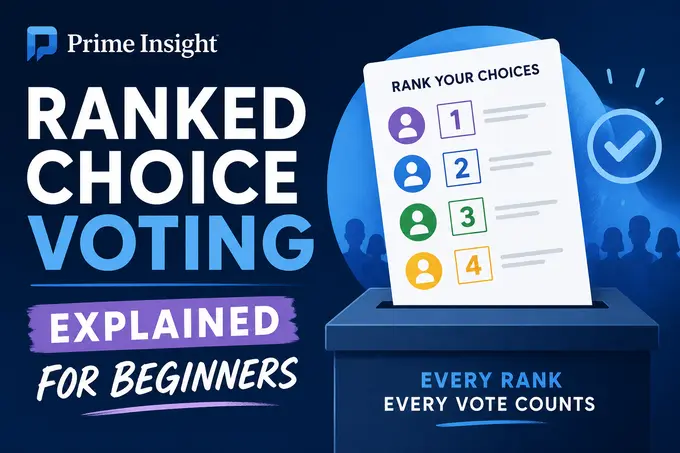
Are you tired of elections where the winner often gets less than half the votes? Or frustrated always choosing the “lesser of two evils”? Ranked Choice Voting is a fairer and smarter system that’s gaining popularity across the world.
In this easy guide, we’ll cover Ranked Choice Voting explained for beginners, walk you through how does ranked choice voting work step by step, and share a balanced look at the pros and cons of ranked choice voting. Everything is explained in plain, simple language.
What Is Ranked Choice Voting?

Ranked Choice Voting, also known as RCV or Instant Runoff Voting, is a voting method where you rank candidates in the order you prefer them — 1 for your favorite, 2 for your second favorite, 3 for the next, and so on.
Unlike the traditional system where you pick only one candidate, Ranked Choice Voting lets you express your full opinion. If your top choice doesn’t have enough support, your vote automatically moves to your next preference instead of being wasted.
Ranked Choice Voting explained for beginners is really this simple: It helps your vote count more meaningfully and gives you the freedom to support candidates you truly like.
How Does Ranked Choice Voting Work Step by Step?
Here’s a clear, beginner-friendly breakdown of how does ranked choice voting work step by step:
Step 1: Fill Out Your Ballot You see a list of candidates. Rank them by preference:
- Put 1 next to your favorite candidate
- Put 2 next to your second choice
- Put 3 next to your third choice You can rank as many as you like. Ranking more helps your vote stay active longer.
Step 2: Count First Choices All the number 1 votes are added up. If any candidate gets more than 50% of the votes, they win right away.
Step 3: Eliminate and Transfer Votes If no one reaches 50%, the candidate with the fewest first-choice votes is eliminated. The votes for that eliminated candidate move to the voters’ second choice (number 2). All votes are recounted with the new totals.
This process of eliminating the lowest candidate and transferring votes repeats round after round until one candidate reaches more than 50% support.
Simple Example of How Ranked Choice Voting Works
Imagine 100 people voting for ice cream flavors: Chocolate, Vanilla, Strawberry, and Mango.
Round 1:
- Chocolate: 40 votes
- Vanilla: 30 votes
- Strawberry: 20 votes
- Mango: 10 votes
No one has over 50%, so Mango is eliminated. The 10 people who chose Mango first had ranked Strawberry or Vanilla second. Those votes transfer.

Round 2:
- Chocolate: 40
- Vanilla: 34
- Strawberry: 26
Strawberry is eliminated next. In the final round, Chocolate gets 55 votes and wins with a true majority.
This example shows the power of Ranked Choice Voting — the winner has support from more than half the voters, not just the largest minority.
How Ranked Choice Voting Prevents the Spoiler Effect
In traditional elections, voting for your favorite can sometimes split votes and help the candidate you like least to win.
With Ranked Choice Voting, you can safely rank your true favorite as #1 and your acceptable second choice as #2. Your vote transfers automatically if needed. This removes the fear of wasting your vote.
Where Ranked Choice Voting Is Used
Ranked Choice Voting is already working well in many places:
- U.S. states like Maine and Alaska
- Cities including New York City, San Francisco, and Minneapolis
- Countries like Australia and Ireland
Most voters say the system feels easy after trying it once or twice.
Pros and Cons of Ranked Choice Voting
Here’s an honest look at the pros and cons of ranked choice voting:
Pros of Ranked Choice Voting
- Winners usually have true majority support (over 50%)
- Encourages candidates to run positive campaigns
- Reduces negative attack ads
- More choices for voters, including independents and third-party candidates
- Fewer wasted votes
- Saves money by avoiding separate runoff elections
Cons of Ranked Choice Voting
- Some voters find ranking confusing at first
- Results take longer to count (usually a few days)
- Needs good voter education and updated equipment
- Possibility of ballot exhaustion if voters rank too few candidates
- Sometimes the candidate with the most first choices can still lose
Overall, most studies show the advantages are stronger once people get used to the system.
Frequently Asked Questions
Q. Is Ranked Choice Voting hard to use?
A. For most people, no. One or two practice ballots make it very easy.
Q. Can my vote disappear?
A. Only if you rank very few candidates and all of them get eliminated, which is uncommon.
Q. Who benefits most from this system?
A. Moderate candidates, independents, women, and minority candidates often perform better.
Final Thoughts
Ranked Choice Voting explained for beginners doesn’t have to be complicated. Once you understand how does ranked choice voting work step by step, you’ll see why it’s becoming popular.
While it has some challenges, the pros and cons of ranked choice voting show it generally leads to fairer results, better voter choice, and less polarized elections.
Next time you see Ranked Choice Voting on a ballot, you’ll know exactly how to use it — and why it matters for better democracy.

তন্ময় ‘প্রাইমইনসাইট’ (PrimeInsight)-এর প্রতিষ্ঠাতা ও প্রধান লেখক। কলকাতা-ভিত্তিক একজন উৎসাহী ব্লগার ও স্বতন্ত্র ভাষ্যকার হিসেবে তিনি গুরুত্বপূর্ণ বিষয়গুলোর ওপর তীক্ষ্ণ ও বাস্তবসম্মত দৃষ্টিভঙ্গি তুলে ধরেন।
সঙ্গীত, সমসাময়িক ঘটনাপ্রবাহ এবং রাজনীতি—এই ক্ষেত্রগুলোতে গভীর জ্ঞানের অধিকারী ইন্দ্রজিৎ তাঁর লেখায় সাংস্কৃতিক উপলব্ধির সাথে রাজনৈতিক বিশ্লেষণের সমন্বয় ঘটান। জাতীয় ও বৈশ্বিক ঘটনাবলির সাথে সংযোগ বজায় রাখার পাশাপাশি তাঁর লেখায় কলকাতার বৌদ্ধিক ও শৈল্পিক সত্তার প্রতিফলনও ফুটে ওঠে।