 By Tanmay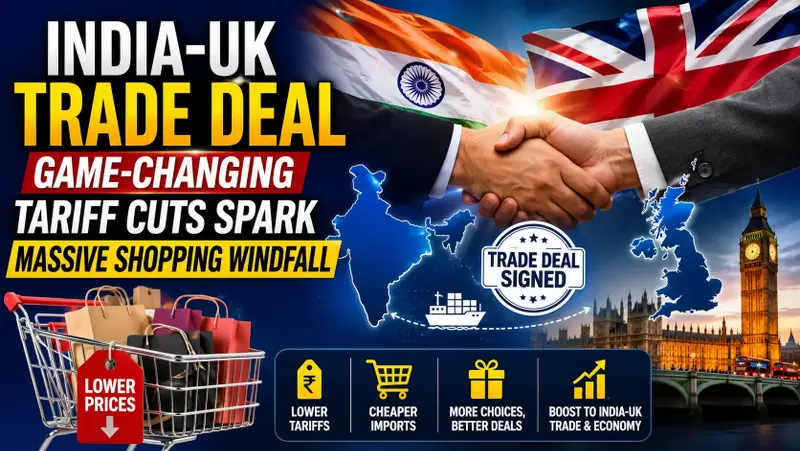
The historic India-UK Trade Deal officially goes live today. Discover which luxury cars, Scotch whiskies, and lifestyle imports are getting dramatically cheaper.
New Delhi: The historic India-UK Trade Deal, formally recognized as the Comprehensive Economic and Trade Agreement (CETA), officially came into force today, July 15, 2026. This monumental accord completely rewrites the rules of bilateral commerce between the two powerhouse nations, unlocking a multi-billion dollar trade corridor. Alongside the primary trade agreement, both governments have activated the highly anticipated Double Contribution Convention (DCC)—a progressive social security pact engineered to dramatically ease professional mobility.
For consumers in India, the most exciting immediate takeaway is a major price reduction on high-end British imports. For businesses, it marks a borderless era of growth as longstanding tariff barriers crumble overnight.
What Gets Cheaper Under the India-UK Trade Deal?
The first noticeable consumer triumph of the India-UK Trade Deal is a swift, aggressive reduction in the prices of iconic British goods entering the Indian market. Luxury retail, automotive, and beverage sectors are preparing for immediate changes.
Historically, India has maintained defensive tariff walls on foreign goods. Under this new framework, those walls are coming down:
-
Luxury Cars & EVs: Tariffs on prestigious British automobiles and electric vehicles, which previously stood at a punishing 110%, are being slashed to a mere 10% under a newly established preferential import quota.
-
Scotch Whisky and Spirits: The legendary 150% import duty on British spirits drops immediately to 75% on day one. Over the next ten years, this tariff will gradually phase down to a highly competitive 40% within specified annual limits.
-
Premium Consumer Goods: High-street cosmetics, medical devices, British chocolates, and traditional biscuits will see progressive tariff rollbacks, making them far more accessible to India’s booming middle-class consumer base.
How the India-UK Trade Deal Empowers Indian Exporters
While Indian shoppers enjoy cheaper imports, Indian manufacturers are celebrating unprecedented, duty-free entry into the United Kingdom. Under the India-UK Trade Deal, the UK has completely eliminated tariffs on approximately 99% of Indian exports from day one.
This zero-duty access provides an incredible competitive edge to key labor-intensive sectors:
| Indian Export Sector | Previous UK Tariff Level | New Tariff Level under Deal |
| Processed Foods | Up to 70% | 0% (Duty-Free) |
| Marine Products & Seafood | Up to 21.5% | 0% (Duty-Free) |
| Engineering & Auto Components | Up to 18% | 0% (Duty-Free) |
| Leather Goods & Footwear | Up to 16% | 0% (Duty-Free) |
| Textiles & Ready-Made Garments | Up to 12% | 0% (Duty-Free) |
This tariff elimination is expected to supercharge profit margins, boost domestic manufacturing, and create hundreds of thousands of new jobs across India’s industrial hubs. Exporters can review the official legal texts on the GOV.UK Trade Portal or the Indian PIB Press Release.
Service Sector Windfalls and Professional Mobility
The reach of the India-UK Trade Deal goes far beyond physical cargo container ships. It is a modern, services-oriented treaty. The simultaneous enforcement of the Double Contribution Convention (DCC) is a massive victory for India’s massive IT and consulting sectors.
Under the newly minted DCC, Indian professionals sent on temporary assignments to the UK for up to five years are now completely exempt from paying double social security taxes, provided they continue contributing to India’s social security system.
Industry experts calculate that this tax exemption will instantly save Indian IT giants millions of dollars annually, making Indian bid proposals far more competitive in the British market. Furthermore, the deal streamlines visa processes and offers predictable mobility pathways for Indian doctors, nurses, accountants, and engineers looking to consult in the UK.
Important Protections Kept: To safeguard local industries, India has strategically kept sensitive sectors entirely out of the trade agreement. Concessions do not apply to dairy products, domestic millets, wheat, edible oils, fresh apples, smartphones, and gold bars.

তন্ময় ‘প্রাইমইনসাইট’ (PrimeInsight)-এর প্রতিষ্ঠাতা ও প্রধান লেখক। কলকাতা-ভিত্তিক একজন উৎসাহী ব্লগার ও স্বতন্ত্র ভাষ্যকার হিসেবে তিনি গুরুত্বপূর্ণ বিষয়গুলোর ওপর তীক্ষ্ণ ও বাস্তবসম্মত দৃষ্টিভঙ্গি তুলে ধরেন।
সঙ্গীত, সমসাময়িক ঘটনাপ্রবাহ এবং রাজনীতি—এই ক্ষেত্রগুলোতে গভীর জ্ঞানের অধিকারী ইন্দ্রজিৎ তাঁর লেখায় সাংস্কৃতিক উপলব্ধির সাথে রাজনৈতিক বিশ্লেষণের সমন্বয় ঘটান। জাতীয় ও বৈশ্বিক ঘটনাবলির সাথে সংযোগ বজায় রাখার পাশাপাশি তাঁর লেখায় কলকাতার বৌদ্ধিক ও শৈল্পিক সত্তার প্রতিফলনও ফুটে ওঠে।