 By Tanmay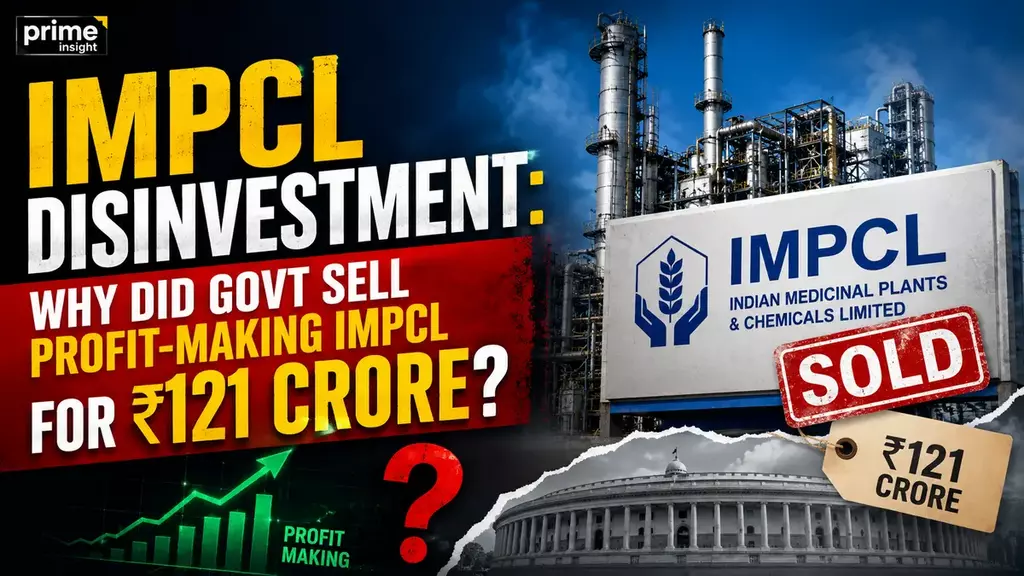
The IMPCL disinvestment is complete. Discover why the government sold the 47-year-old, profit-making AYUSH Ministry pharma PSU for just ₹121 crore.
NEW DELHI — The IMPCL disinvestment has officially been approved by the Central Government, marking a 100% strategic sale of its 47-year-old public sector enterprise, Indian Medicines Pharmaceutical Corporation Limited. This move has instantly reignited fierce nationwide debates surrounding India’s asset monetisation and privatization drive.
The Alternative Mechanism—an empowered Group of Ministers including the Union Finance Minister and the Minister for Road Transport and Highways—approved the highest financial bid of ₹121.01 crore ($\text{₹}121,00,94,400$) submitted by Delhi-based private player M/s. Skymap Pharmaceuticals Private Limited. This definitive IMPCL sale price hands over absolute management control and 100% equity shareholding of the legacy company to private hands.
While the government highlights that the bid cleared the set “reserve price” threshold through a transparent, two-stage open competitive process, public policy analysts are raising crucial questions regarding the commercial valuation and the necessity of offloading a consistent profit-earning PSU.
A Legacy Built on Public Trust: What is IMPCL?
Founded on July 12, 1978, and headquartered in Almora, Uttarakhand, Indian Medicines Pharmaceutical Corporation Limited has operated as a Central Public Sector Enterprise (CPSE) under the administrative jurisdiction of the Ministry of AYUSH. For nearly five decades, the company served as a crucial bedrock for the traditional medicine sector in India, manufacturing and supplying nearly 1,200 standardized, classical, and proprietary Ayurvedic and Unani formulations across the country.
Built via public tax revenue and sustained through years of state patronage, this AYUSH ministry PSU sale marks the end of a vital commercial arm that ensured the availability of reliable alternative healthcare.
The Core Contradiction: Profit-Making PSU Privatization
The loudest criticism surrounding the IMPCL strategic sale stems from a basic financial reality: IMPCL was not an ailing, debt-ridden entity, as highlighted in the video report. Public financial records and recent data reveal a steady stream of net profits over consecutive fiscal years:
-
2019–20: ₹0.45 Crore
-
2020–21: ₹11.05 Crore
-
2021–22: ₹33.76 Crore
-
2022–23: ₹20.81 Crore
-
2023–24: ₹12.81 Crore
While the company saw a minor dip in net profits during the 2023–24 fiscal timeline compared to its peak performance in 2021–22, it remained fundamentally in the green. Historically, privatization models are reserved for loss-making public utilities straining the national exchequer. Critics of profit making PSU privatization are asking: If the state begins to sell off its consistently high-performing, revenue-generating mechanisms, what long-term commercial assets will it rely on?
Valuation Scrutiny: Does the Skymap Pharmaceuticals Bid Make Sense?
Beyond its operational profitability, the financial specifics of the acquisition by Skymap Pharmaceuticals have drawn intense market scrutiny. Preliminary financial assessments from available public data highlight striking disparities:
-
As of March 31, 2022, IMPCL boasted total assets valued at approximately ₹260.36 crore—more than double the final approved private bid.
-
Around that same period, the company held nearly ₹116.46 crore strictly in cash and cash equivalents.
Effectively, the strategic buyer acquired a massive production infrastructure, extensive manufacturing real estate, a robust institutional footprint in the rapidly expanding AYUSH sector, and a deep portfolio of medical formulations for an amount almost equal to the cash the company historically held in its accounts.
West Bengal Smart Meter Protest: ABECA Mobilizes Against July Rollout
The Broadening Horizon of Asset Monetisation
The offloading of IMPCL follows a broader national economic blueprint. Over the past few years, the government has aggressively pursued disinvestment targets, liquidating portions of state ownership across major sectors, including airports, sea ports, and heavy infrastructure.k
While the Department of Investment and Public Asset Management (DIPAM) maintains that strategic sales unlock corporate efficiency and reduce unnecessary government interference in purely commercial sectors, the transition of traditional medicinal systems into entirely private, margin-driven enterprises creates public uncertainty regarding future affordability and standard access.
With the Letter of Award already handed to Skymap Pharmaceuticals Private Limited, the Secretaries of DIPAM and AYUSH are on track for a swift, complete closure of the transaction. The doors of IMPCL close on its state-owned legacy, leaving behind a profound question for the public: Are we valuing short-term fiscal targets at the cost of long-term public wealth?
Prime Insight Opinion: What are your thoughts on the sale of profit-making PSUs? Let us know in the comments below.

তন্ময় ‘প্রাইমইনসাইট’ (PrimeInsight)-এর প্রতিষ্ঠাতা ও প্রধান লেখক। কলকাতা-ভিত্তিক একজন উৎসাহী ব্লগার ও স্বতন্ত্র ভাষ্যকার হিসেবে তিনি গুরুত্বপূর্ণ বিষয়গুলোর ওপর তীক্ষ্ণ ও বাস্তবসম্মত দৃষ্টিভঙ্গি তুলে ধরেন।
সঙ্গীত, সমসাময়িক ঘটনাপ্রবাহ এবং রাজনীতি—এই ক্ষেত্রগুলোতে গভীর জ্ঞানের অধিকারী ইন্দ্রজিৎ তাঁর লেখায় সাংস্কৃতিক উপলব্ধির সাথে রাজনৈতিক বিশ্লেষণের সমন্বয় ঘটান। জাতীয় ও বৈশ্বিক ঘটনাবলির সাথে সংযোগ বজায় রাখার পাশাপাশি তাঁর লেখায় কলকাতার বৌদ্ধিক ও শৈল্পিক সত্তার প্রতিফলনও ফুটে ওঠে।