 By Tanmay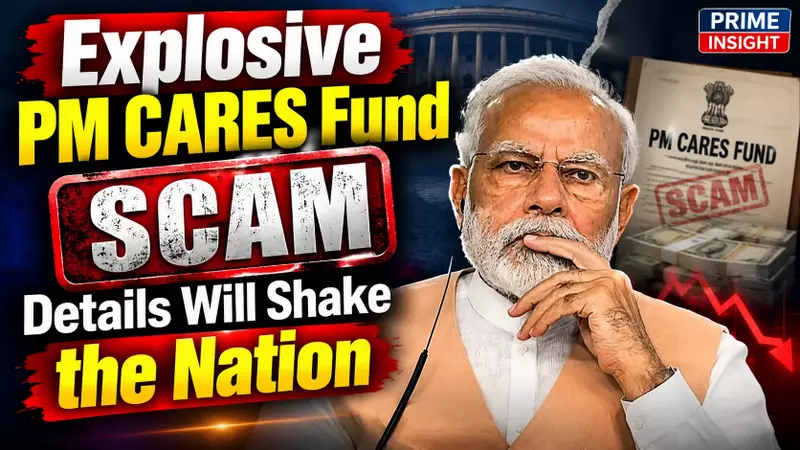
Explosive PM CARES Fund Scam questions grow as the fund stays outside RTI. Learn about PM CARES fund total amount, whether it is private or government, donations, and ownership.
New Delhi: PM CARES Fund transparency has returned to the spotlight after reports confirmed that audited financial statements have not been made public since the 2022-23 financial year. The last available accounts show a closing balance of around ₹6,284 crore as of 31 March 2023, but no further audited figures have been released.
The Prime Minister’s Citizen Assistance and Relief in Emergency Situations Fund, better known as the PM CARES Fund, was created on 27 March 2020 during the early months of the COVID-19 pandemic. It was registered as a public charitable trust under the Registration Act, 1908. The Prime Minister serves as ex-officio Chairperson, while the Defence Minister, Home Minister and Finance Minister are ex-officio trustees. Additional trustees have been nominated from time to time.
PM CARES Fund Total Amount Collected
According to the last published audited statements available on the fund’s website and reported by multiple news organisations, total receipts crossed ₹13,000 crore in the first three years.
- 2019-20: approximately ₹3,076 crore
- 2020-21: approximately ₹10,990 crore
- Subsequent years saw lower but continuing voluntary contributions
By the end of March 2023 the fund held a closing balance of ₹6,283.68 crore. Interest income and refunds also contributed to the corpus. No detailed audited statements for FY 2023-24 or later have been placed in the public domain as of early August 2026.
Is the PM CARES Fund Private or Government?
The government has consistently maintained that the PM CARES Fund is a private public charitable trust and not a government fund. In affidavits filed in the Delhi High Court, the Centre has stated that the trust is “neither intended to be nor is in fact owned, controlled or substantially financed by any government.” Donations do not form part of the Consolidated Fund of India.
Because of this legal position, the fund has been held to fall outside the definition of a “public authority” under the Right to Information Act, 2005. The Delhi High Court has upheld this view in earlier proceedings, though limited disclosure of certain documents was directed in some cases. The fund is also not subject to audit by the Comptroller and Auditor General of India. Private chartered accountants have been appointed as auditors.
Despite the legal characterisation, the fund uses the national emblem, operates from a .gov.in domain, and is administered with support from officials linked to the Prime Minister’s Office. This has fuelled ongoing public debate about its exact status.
PM CARES Fund Audited Statement
PM CARES Fund Donations and Sources
The fund accepts only voluntary contributions from individuals, organisations and companies (including CSR funds). Contributions from the budgetary resources of public sector undertakings are not accepted, according to official FAQs. Large private groups, public sector companies and ordinary citizens contributed during the pandemic years. Some foreign contributions were also received; the fund was granted exemption from certain provisions of the Foreign Contribution (Regulation) Act.
Exact lists of all donors and the precise amounts given by each have not been published in full. Summary figures of total receipts appear in the available audited accounts.
How the Money Was Spent
Available records show that the bulk of expenditure went towards COVID-19 related needs:
- Procurement of around 50,000 Made-in-India ventilators
- Installation of Pressure Swing Adsorption (PSA) medical oxygen plants in public health facilities
- Purchase of COVID-19 vaccine doses
- Support for vaccine research and development
- Temporary COVID hospitals and RT-PCR testing laboratories
- Financial assistance to states for migrant workers during the 2020 lockdown
- Later schemes such as support for children who lost parents or guardians during the pandemic
Supporters point to these interventions as evidence that the fund delivered tangible help at a time of national emergency. Critics argue that the absence of regular, detailed and independently verifiable public accounts makes it difficult for citizens to assess efficiency, quality of equipment or residual balances.
Ownership and Control of the PM CARES Fund
There is no single private owner. The trust itself holds the funds. Decision-making rests with the board of trustees headed by the Prime Minister. Day-to-day administration is handled by designated officials. The trust deed states that the inclusion of ministers as trustees is for administrative convenience and does not amount to government control.
The Transparency Debate
The core issue remains whether a fund that collects public donations, carries the name of the Prime Minister, and is chaired by the country’s highest elected official should be subject to the same transparency standards as other public authorities.
Those who defend the present arrangement say the private-trust structure allowed faster response during the pandemic and that summary accounts and project announcements already provide sufficient information.
Those who seek greater scrutiny say every citizen who donated has a legitimate interest in knowing how the money was collected, managed and spent, and that full RTI coverage, CAG audit and regular publication of audited statements would strengthen rather than weaken public confidence.
Recent reports about irregularities in the counting of donations at the Ram Mandir in Ayodhya have made some citizens more sensitive to questions of financial accountability in any institution that receives public contributions. The two matters are legally and structurally separate, yet both have kept the broader conversation about transparency alive.
What Happens Next
As of August 2026, the PM CARES Fund continues to exist as a registered public charitable trust. No new audited financial statements have been released for the years after 2022-23. Legal challenges seeking fuller disclosure under the RTI Act remain part of the public record. The government maintains its position that the fund is not a public authority.
The debate is ultimately about a basic democratic principle: when large sums of money are collected from the public in the name of national emergency relief, how much openness is required. Clear, regular and independently verified accounts remain the simplest way to answer that question.
External resources:
- Official PM CARES website and FAQs: https://pmcares.gov.in
- Detailed reporting on missing audited statements: The Hindu
- Wikipedia overview with references: https://en.wikipedia.org/wiki/PM_CARES_Fund
- Court and transparency analysis: The Wire

তন্ময় ‘প্রাইমইনসাইট’ (PrimeInsight)-এর প্রতিষ্ঠাতা ও প্রধান লেখক। কলকাতা-ভিত্তিক একজন উৎসাহী ব্লগার ও স্বতন্ত্র ভাষ্যকার হিসেবে তিনি গুরুত্বপূর্ণ বিষয়গুলোর ওপর তীক্ষ্ণ ও বাস্তবসম্মত দৃষ্টিভঙ্গি তুলে ধরেন।
সঙ্গীত, সমসাময়িক ঘটনাপ্রবাহ এবং রাজনীতি—এই ক্ষেত্রগুলোতে গভীর জ্ঞানের অধিকারী ইন্দ্রজিৎ তাঁর লেখায় সাংস্কৃতিক উপলব্ধির সাথে রাজনৈতিক বিশ্লেষণের সমন্বয় ঘটান। জাতীয় ও বৈশ্বিক ঘটনাবলির সাথে সংযোগ বজায় রাখার পাশাপাশি তাঁর লেখায় কলকাতার বৌদ্ধিক ও শৈল্পিক সত্তার প্রতিফলনও ফুটে ওঠে।